In continuous manufacturing environments, failure rarely originates with production equipment; it more often begins with overlooked infrastructure that only draws attention once it disrupts output. At a leading beverage producer’s facility in Hungary, this became evident when deteriorating flooring in the syrup room began to compromise hygiene, safety, and production continuity.
At this stage, the issue was no longer technical, it represented operational risk embedded within the process environment. From an operations management perspective, this reflects a shift from reactive maintenance to proactive risk mitigation, where infrastructure failure is treated as a systemic threat rather than an isolated defect. The response therefore required more than repair; it required eliminating a failure point without interrupting production.
Challenges & Customer Requirements
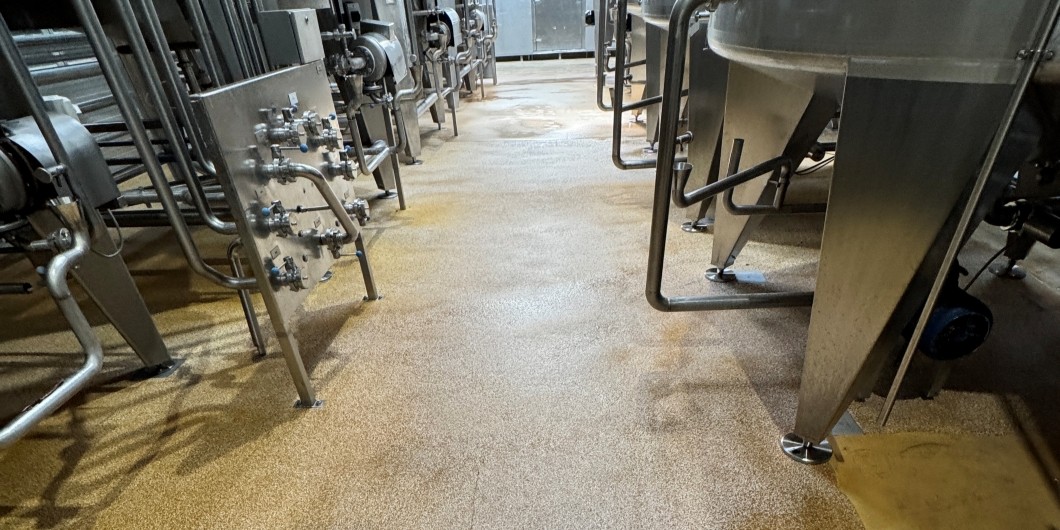
After more than 25 years of service, the syrup room floor had reached structural failure. Multiple generations of resin coatings and mortars had been applied over original ceramic tiles, creating a layered system that concealed degradation rather than resolving it.
This resulted in a convergence of risks: water ingress accelerating substrate deterioration, delamination undermining load-bearing performance, loss of EHS and hygiene compliance, and increasing exposure to unplanned production disruption. In operations terms, this represents an accumulation of hidden failure modes, where short-term fixes increase long-term system vulnerability.
Critically, any extended shutdown would have had immediate operational and financial consequences. The requirement was therefore not just technical performance, but intervention without disruption. The client required a system capable of restoring structural integrity to food-grade standards, while withstanding chemical exposure, mechanical stress, and CIP regimes, and ensuring safe working conditions. Delivery within a live environment and elimination of recurring maintenance cycles were essential.
Solution
Stonnhard implemented a full build-up resin flooring system, removing all compromised material and rebuilding from a stable substrate upward. This approach aligns with reliability engineering principles, where root causes are eliminated rather than managed through repeated intervention.
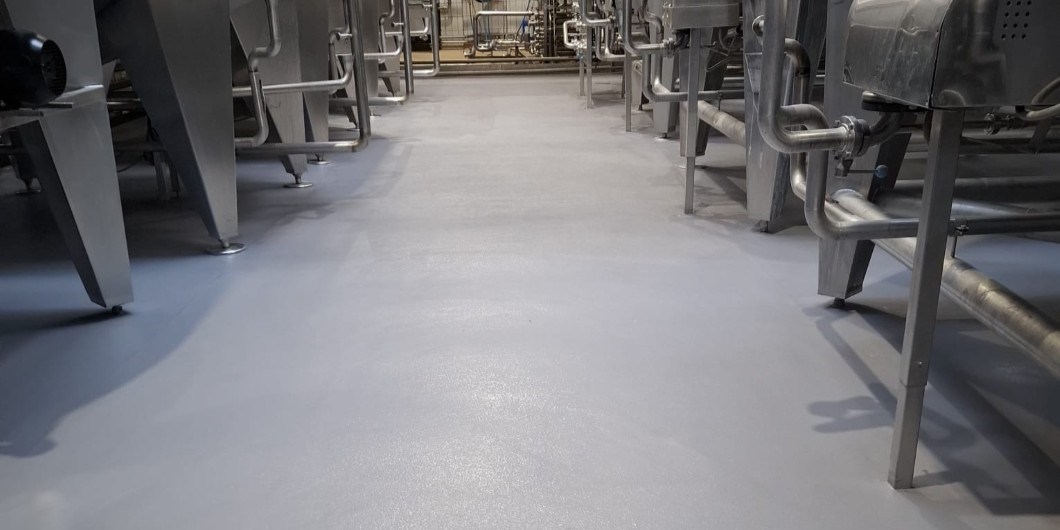
The scope included removal of the unstable substrate and installation of a 420m² integrated system incorporating grout, mortar, and sealer layers. Structural integrity was restored using Stonset TG6, with Stonclad UR applied for detailing and seamless coving, and Stonclad UT Light as the final textured surface for durability and slip resistance. Each layer was bacteriostatic, supporting hygiene compliance.
Execution within a live environment required a phased strategy. The syrup room was divided into two zones, allowing continuous operation while installation progressed. However, while this approach ensured zero downtime, it introduced operational complexity, requiring precise coordination and environmental control to mitigate cross-contamination risks. Foil curtain containment systems were therefore critical in maintaining separation and ensuring both production continuity and installation integrity.
The result is not simply an upgraded floor, but the removal of a systemic weakness within a critical production zone. The facility achieved zero disruption during installation, alongside improved process reliability and environmental control. The system also provides an extended service lifecycle, reducing future intervention frequency and enhancing safety and hygiene under continuous operating conditions.
From a strategic perspective, this demonstrates the value of shifting from reactive maintenance to engineered resilience. By the root cause of failure, the organisation reduced both direct maintenance costs and the hidden costs associated with operational risk exposure.
Result
This project illustrates a broader operational insight: in continuous production environments, infrastructure should be managed as a strategic asset rather than a maintenance concern. Addressing failure at source, rather than repeatedly managing its symptoms, enables organisations to reduce risk, improve reliability, and enhance long-term performance.
The case demonstrates that the most effective interventions are those that remove systemic risk without introducing disruption—requiring a shift from reactive problem-solving to system-level resilience.
Contact us for more information.